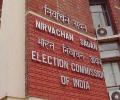
The State Bank of India has not shared details of the electoral bonds encashed by political parties till Wednesday, the deadline set by the Supreme Court.

'Corporates who donated to political parties were guaranteed by the electoral bond scheme that their names and to who they were donating funds will be not disclosed.'

The State Bank of India (SBI) on Wednesday told the Supreme Court that a total of 22,217 electoral bonds were purchased by donors between April 1, 2019 and February 15 this year, out of which 22,030 were redeemed by political parties.

The Supreme Court on Monday referred to a five-judge Constitution bench a batch of pleas challenging the validity of the electoral bond scheme for political funding of parties.

The Congress on Friday alleged that the electoral bonds data has exposed 'corrupt tactics' of the Bharatiya Janata Party such as quid pro quo, seeking donations for the company's protection, kickbacks and money laundering through shell companies.

The National People's Party, which rules Meghalaya, is another national party which received no donations through electoral bonds.
From steel tycoon Lakshmi Mittal to billionaire Sunil Bharti Mittal's Airtel, Anil Agarwal's Vedanta, ITC, Mahindra and Mahindra, and a lesser-known Future Gaming and Hotel Services were among the prominent buyers of the now-scrapped electoral bonds for making political donations.

Despite the objections raised by Reserve Bank of India and Election Commission, India's politics has been funded anonymously and it is time to end this, asserts Aakar Patel.

The State Bank of India told the Supreme Court on Thursday it has provided all details of the electoral bonds in its possession to the Election Commission.
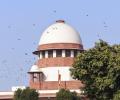
A five-judge constitution bench of the Supreme Court is scheduled to commence hearing from October 31 a batch of pleas challenging the validity of the electoral bond scheme for political funding of parties.

The apex court bench, also comprising justices Sanjiv Khanna, BR Gavai, JB Pardiwala, and Manoj Misra, will assemble at 10.30 am to hear the two petitions.
The bench, headed by Chief Justice D Y Chandrachud, will also hear a separate plea which has sought initiation of contempt action against the SBI alleging it "wilfully and deliberately" disobeyed the apex court's direction to submit details of the contributions made to political parties through electoral bonds to the Election Commission by March 6.

Chastising the State Bank of India, the Supreme Court on Monday ordered it to disclose the details of the electoral bonds encashed by political parties to the Election Commission by the close of the business hours on March 12 and warned the country's largest public sector lender that the court may proceed against it for 'wilful disobedience' if it failed to comply with its directions and deadlines.

"But the BJP wants it to be done after Lok Sabha elections. The tenure of this Lok Sabha will end on 16th June and SBI wants to share the data by 30th June," Kharge said.
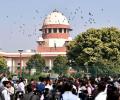
In a landmark judgment that delivered a big blow to the government, the Supreme Court on Thursday annulled the electoral bonds scheme, saying it violates the constitutional right to freedom of speech and expression as well as the right to information.

In its verdict last month, the top court directed the SBI to furnish the details to the Election Commission (EC) by March 6.

Not ordering disclosure of details of electoral bonds prior to April 12, 2019, was a "conscious choice" by the Constitution bench, the Supreme Court said on Monday while refusing to entertain the submissions of ASSOCHAM and CII against the disclosure of bond details on the ground of their plea not being listed.

A bench comprising Justices Sanjiv Khanna and Dipankar Datta took note of the submissions of lawyer Prashant Bhushan, appearing for NGOs 'Common Cause' and the Centre for Public Interest Litigation, that the plea needed to be listed for hearing at the earliest.

Noting that he fully respects the Supreme Court order on electoral bonds, Union Home Minister Amit Shah on Friday said the scheme was introduced to end black money in politics and added that it should have been improved rather than scrapped.

The Congress, on the other hand, earned Rs 171 crore from electoral bonds which was down from Rs 236 crore in FY 2021-22.

The Congress on Wednesday questioned the Election Commission's move to get a post on electoral bonds scheme deleted from social media platform X and said that the issue raised in the post makes the government 'extremely uncomfortable'.
Congress general secretary in-charge communications Jairam Ramesh said "surprisingly" the prime minister is grounded in New Delhi on Wednesday and not travelling around the country for new "inaugurations", for rebranding, or for claiming credit for past work.

A five-judge Constitution bench of the Supreme Court is scheduled to commence a crucial hearing from Tuesday on a batch of pleas challenging the validity of the electoral bonds scheme for funding political parties.

Santiago Martin has funded Rs 1,368 crore to political parties between October 2020 to January 2024 through electoral bonds.

Rajya Sabha MP Kapil Sibal on Friday described the electoral bonds scheme as a 'very big scam' and demanded that a special investigation team (SIT) be set up with court-appointed officials to probe the alleged quid pro quo and wrongdoings under it.

Future Gaming of lottery king Santiago Martin was the biggest purchaser of electoral bonds at Rs 1,368 crore, of which nearly 37 percent went to the DMK.

It bought Rs 410 crore of electoral bonds between financial years 2021-22 and 2023-24, but Reliance said the company is not a subsidiary of any Reliance entity.
State Bank of India on Monday moved the Supreme Court seeking an extension of time till June 30 to disclose details of each electoral bond encashed by political parties.

All political parties put together received more than Rs 12,000 crore till last fiscal since the introduction of the now-annulled electoral bond scheme in 2018, of which the ruling BJP got nearly 55 per cent or Rs 6,565 crore, according to the data available with Election Commission and Association for Democratic Reforms (ADR).

A voter's right to know is 'far too important' in democracy than the privacy of a donor, Supreme Court judge Justice Sanjiv Khanna said on Thursday as the apex court scrapped the 2018 electoral bond scheme for funding political parties.

Megha Engineering and Infrastructures Limited was the top donor to the Bharatiya Janata Party at Rs 584 crore and the Bharat Rashtra Samiti at Rs 195 crore.

Ahead of the assembly elections in Gujarat and Himachal Pradesh, the government on Monday approved the issuance of the 23rd tranche of electoral bonds that will open for sale on November 9.

The issue of electoral bonds has snowballed into a political flashpoint after following reports that said the Reserve Bank of India and Election Commission had reservations against them but they were overrule by the Modi government.

The Supreme Court on Tuesday said it will hear on December 6 the plea of a Congress leader challenging a recent notification by which the sale of electoral bonds has been extended by 15 more days in the year of general elections to legislative assemblies of states and Union territories (UTs) with a legislature.

'Election funding needs a little more transparency.'

In his letter to President Droupadi Murmu, SCBA President Adish C Aggarwala urged her to seek presidential reference of the apex court judgement in the electoral bonds scheme case.

'This mega corruption scandal, as certified by the Supreme Court, will expose the unholy nexus between the BJP and its corrupt corporate masters'

A bench comprising Chief Justice of India DY Chandrachud and Justice PS Narasimha said the petitions raise three separate issues and hence, the need to hear them separately.
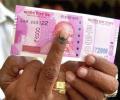
Between 2016-17 and 2021-22, the last year for which the data is available, seven national parties and 24 regional parties received a total donation of Rs 9,188.35 crore through electoral bonds.
The Supreme Court Wednesday flagged the issue of possible misuse of funds received through electoral bonds by political parties for illegal purposes like terrorism and asked the Centre whether there was any 'control' over how these funds were put to use.
 © 2026 Rediff.com - Advertise with us - Disclaimer - Privacy Policy - Sitemap - Feedback - About us - Terms of use - Grievances